Every child deserves a safe seat at the table.
Lucian is the reason this exists: a child with autism and 30+ severe food allergies whose reactions, eczema, dermatitis, and infection risks made cross-contamination a life-or-death issue.
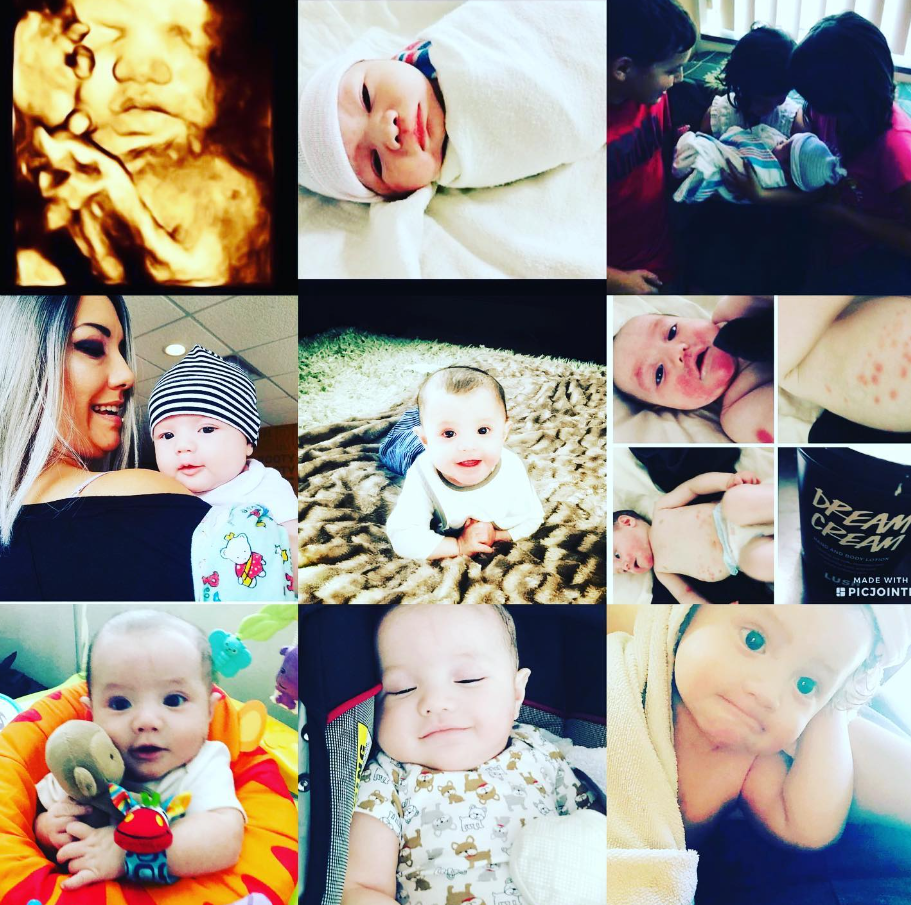
Created because cross-contamination became too dangerous
Lucian was allergic to more than 30 foods, and early on even breastmilk was not safe. At two years old, when safe options were nearly impossible, his mom created a hemp seed formula with rice milk just to help him survive.
As Lucian grew, the cookies, bars, and other safe foods came from the same necessity: when outside manufacturers could not reliably prevent cross-contact or label risks clearly enough, his family had to build the food themselves. This was not a concept — it was life or death.
A real-life food access example
When one safe fast-food option matters
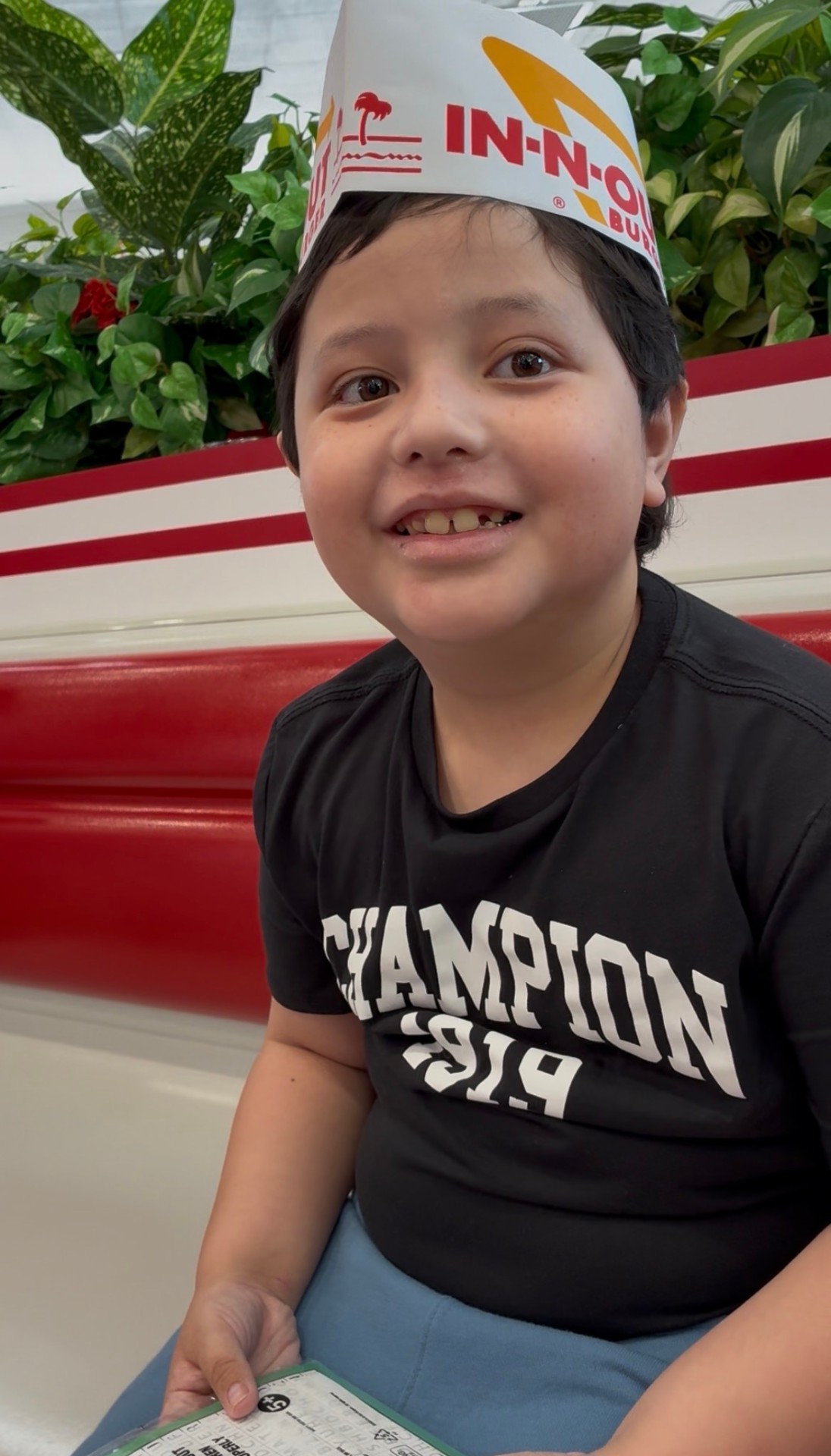
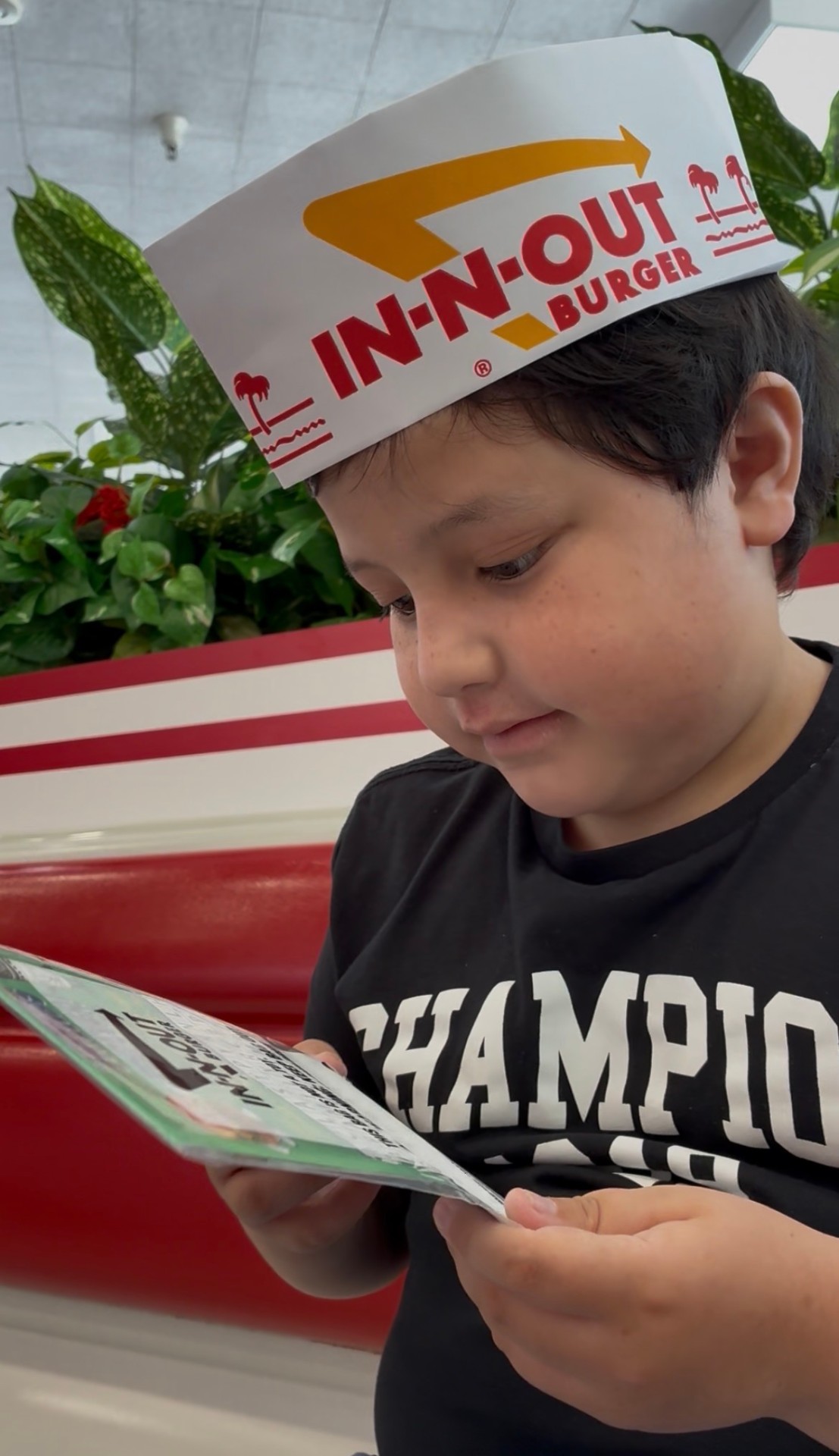
For Lucian, fast food has never been casual. One of the only fast-food items his family has found he can safely have is In-N-Out french fries, because they are made from real potatoes and cooked in sunflower oil rather than soy-based oils or hidden byproducts.
His family has also experienced how important clear allergy communication can be: when told about food allergens, staff can mark the order carefully and separate the food to reduce cross-contact risk. That kind of transparency and procedure is what families like ours need to see become normal everywhere.
Six pillars of impact
Food Allergy Advocacy
Support, awareness, and resources for the millions of children and families navigating life-threatening food allergies.
Autism & Sensory Feeding
Acknowledging that safe food access also means food that works for sensory needs and selective eating.
Family & Community Education
Approachable education on label literacy, cross-contact, allergen safety, and inclusive cooking.
School Meal Inclusion
Working toward a future where no child sits at a separate table because of what they can — or can't — eat.
Healthcare & Underserved Outreach
Future programs supporting hospitals, pediatric care, and communities with limited access to safe nutrition.
Donor & Sponsor Community
A growing community of supporters helping fund awareness, programs, and access initiatives.
Partners, placements & milestones
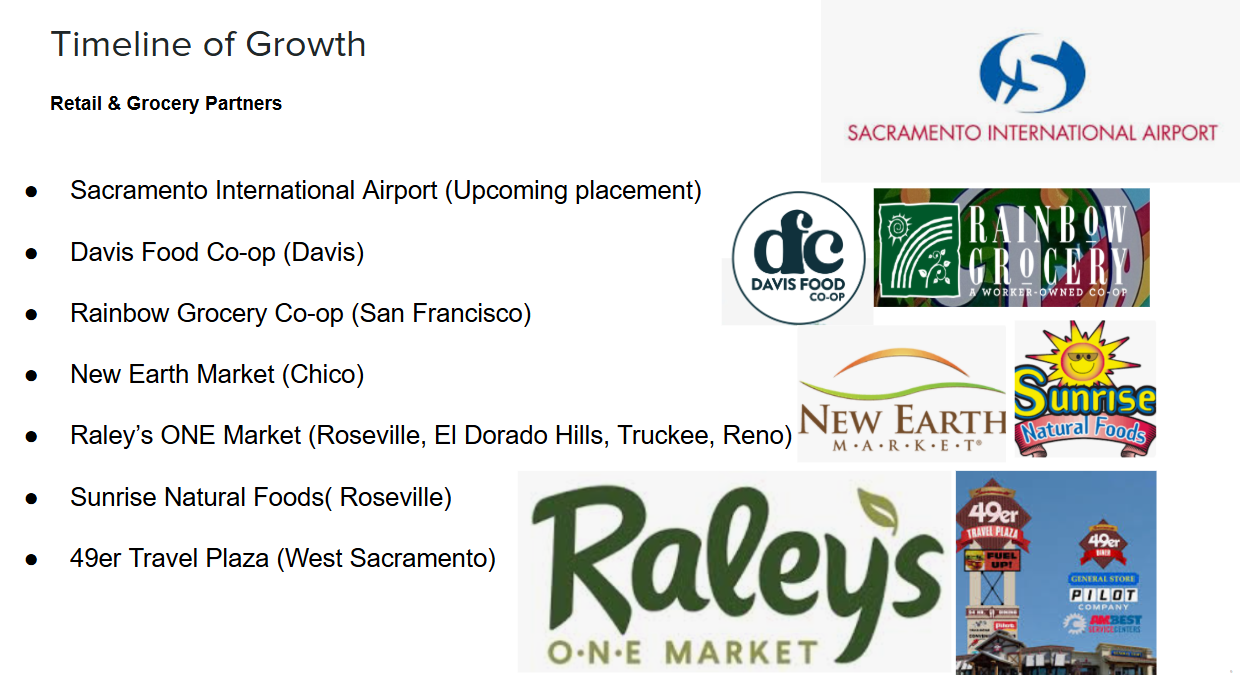
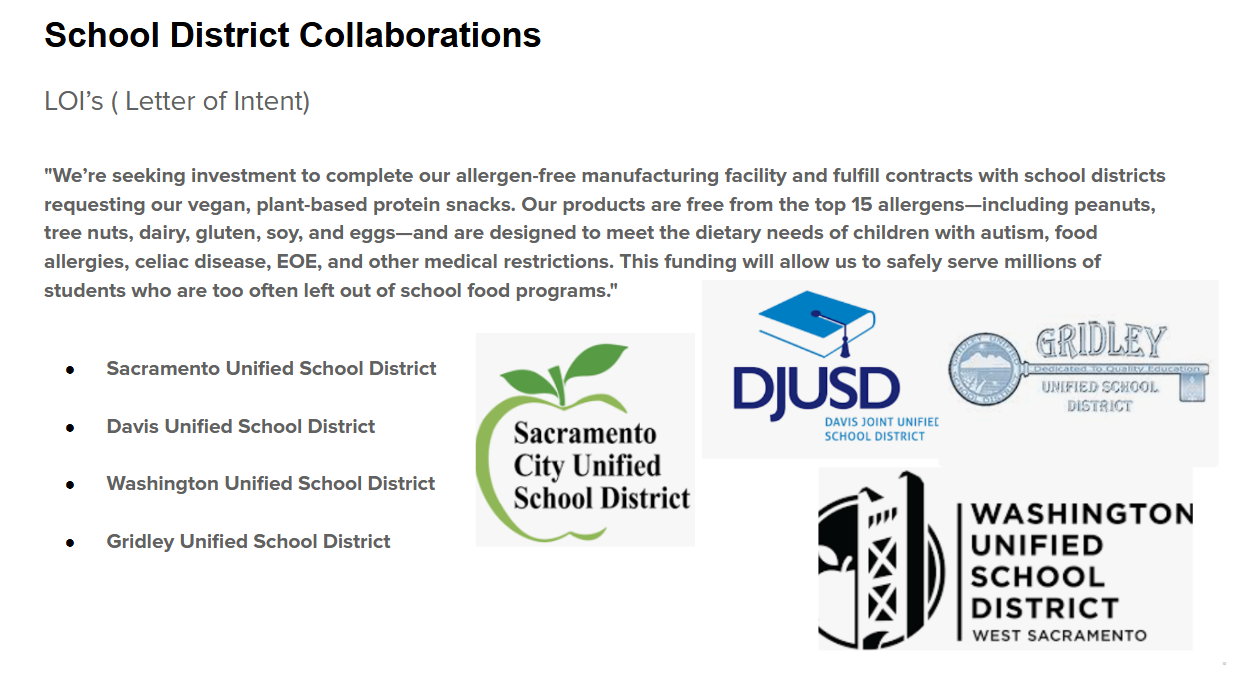
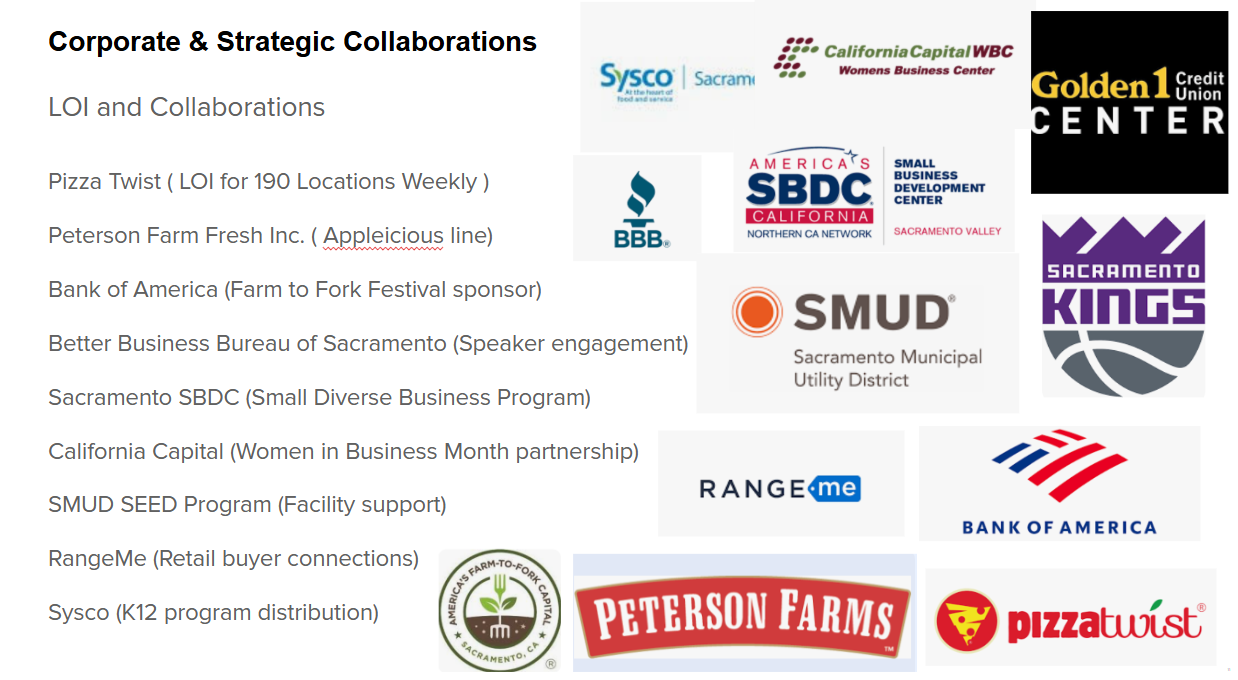
From local co-ops to school districts, corporate partners, and national media — a growing footprint of relationships building safer food access.
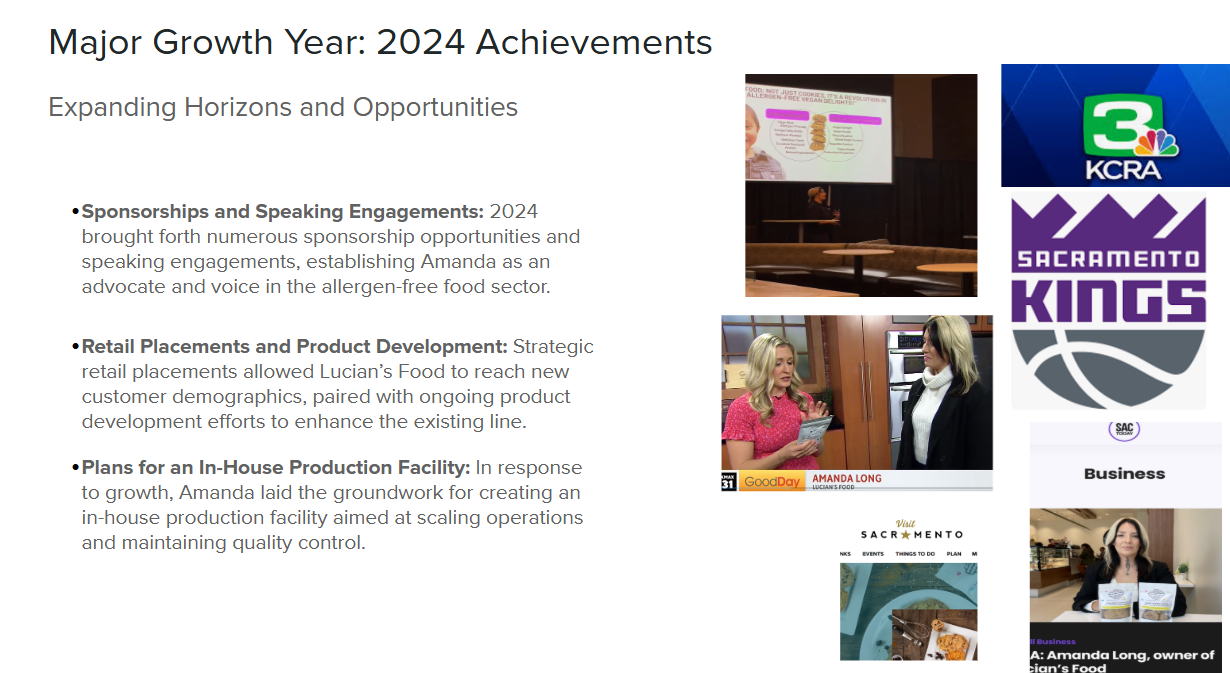
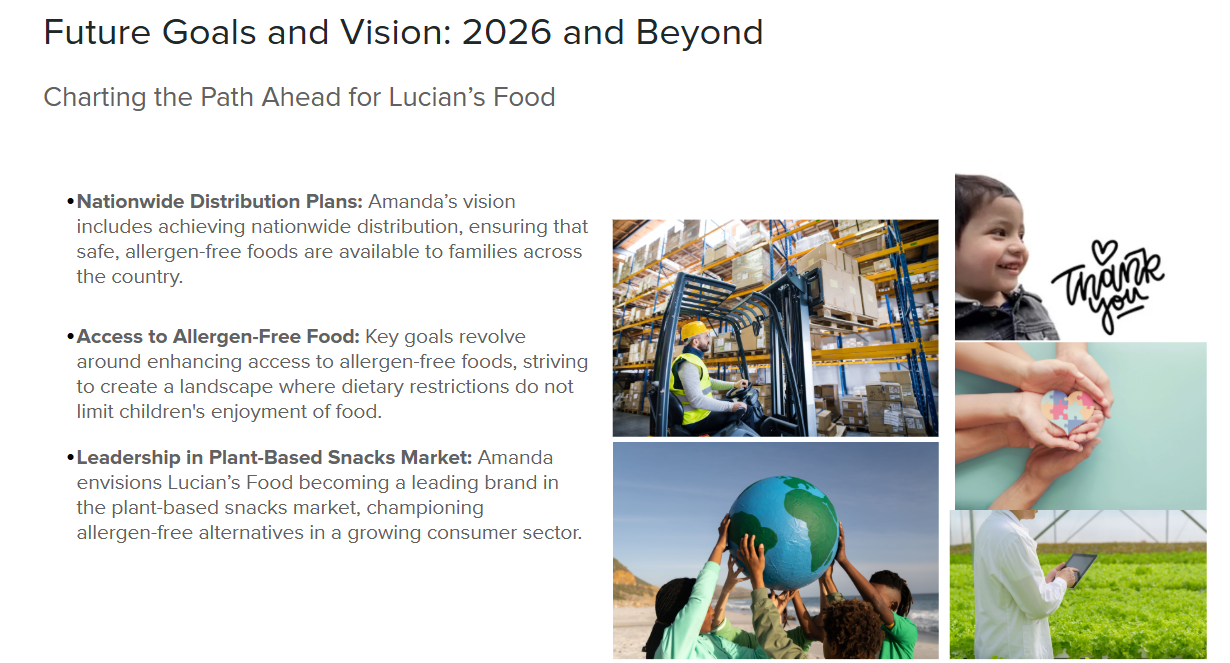
Recognized by the league — not just the community
From arena competitions to media coverage, Lucian's Food has earned independent recognition for its mission, product quality, and growth potential.
Why 30+ allergens — including airborne — make Lucian's life a daily emergency
To understand why a crumb, a smell, or a shared utensil can be life-threatening, you have to understand the immune system mistaking food proteins for invaders.
30+
Confirmed food allergies
Diagnosed across nuts, legumes, grains, dairy, eggs, seeds, fish, shellfish, fruits and additives.
Airborne
Inhalation reactions
Aerosolized fish, shellfish, peanut, milk and wheat proteins can trigger reactions without ingestion.
< 1mg
Threshold dose
For highly sensitized children, less than a milligram of allergenic protein can trigger anaphylaxis.
Minutes
Time to anaphylaxis
Severe reactions typically begin within 5–30 minutes of exposure — sometimes in seconds.
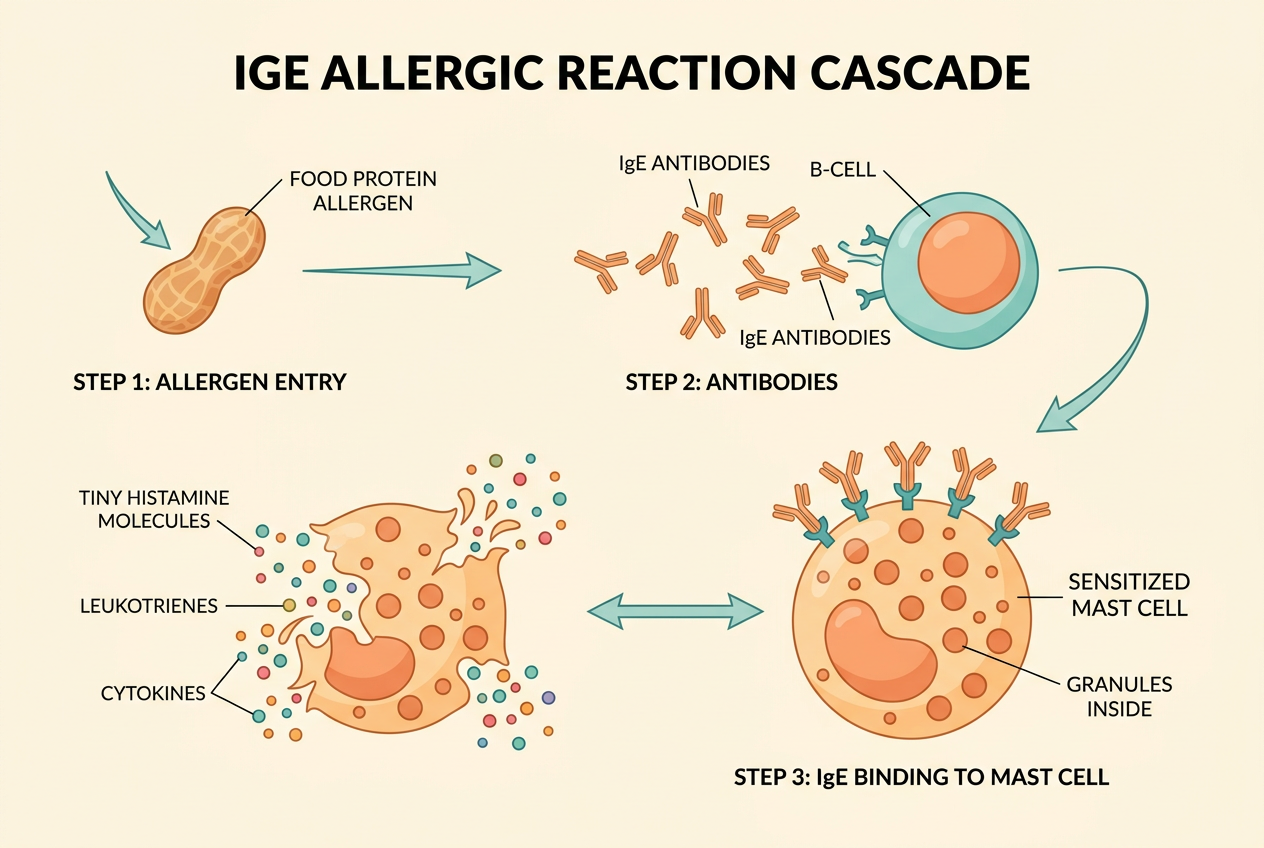
The immune system mistakes food protein for a threat
Food allergens are tiny protein fragments — peanut Ara h 2, milk casein, egg ovomucoid, shrimp tropomyosin. In an allergic child, the immune system flags these proteins as dangerous invaders the very first time it sees them.
Step 2 — IgE antibodies. B-cells produce Y-shaped Immunoglobulin E (IgE) antibodies, custom-built to recognize that exact protein. Millions of these antibodies travel through the bloodstream and lock onto mast cells — immune cells packed with chemical granules — lining the skin, gut, lungs and airway.
Step 3 — Sensitization. The body is now "primed." There may be no symptoms yet. But the next exposure — even microscopic — will trigger an immediate response.
Step 4 — Degranulation. When the protein re-enters the body, it cross-links the IgE on the mast cell surface. The mast cell ruptures and releases a flood of histamine, leukotrienes, prostaglandins, and cytokines — all at once.
What histamine actually does to the body
Histamine is a tiny molecule with massive effects. It binds to H1 receptors throughout the body, triggering an immediate inflammatory response designed to expel a 'pathogen' — even though no pathogen exists.
Blood vessels dilate
Capillaries widen and leak fluid into tissue. Blood pressure crashes. The brain loses oxygen.
Smooth muscle contracts
Bronchial tubes squeeze shut. Breathing becomes a wheeze, then a gasp, then nothing.
Tissue swells (angioedema)
Lips, tongue, throat and face balloon within minutes. The airway can close completely.
Heart races, then fails
Pulse spikes to compensate for falling pressure. Without epinephrine, the heart can stop.
Skin erupts in hives
Itching, flushing, welts. For Lucian, it also worsens chronic eczema and skin infection risk.
Gut violently empties
Cramping, vomiting, diarrhea — the body tries to purge the 'invader' it cannot identify.
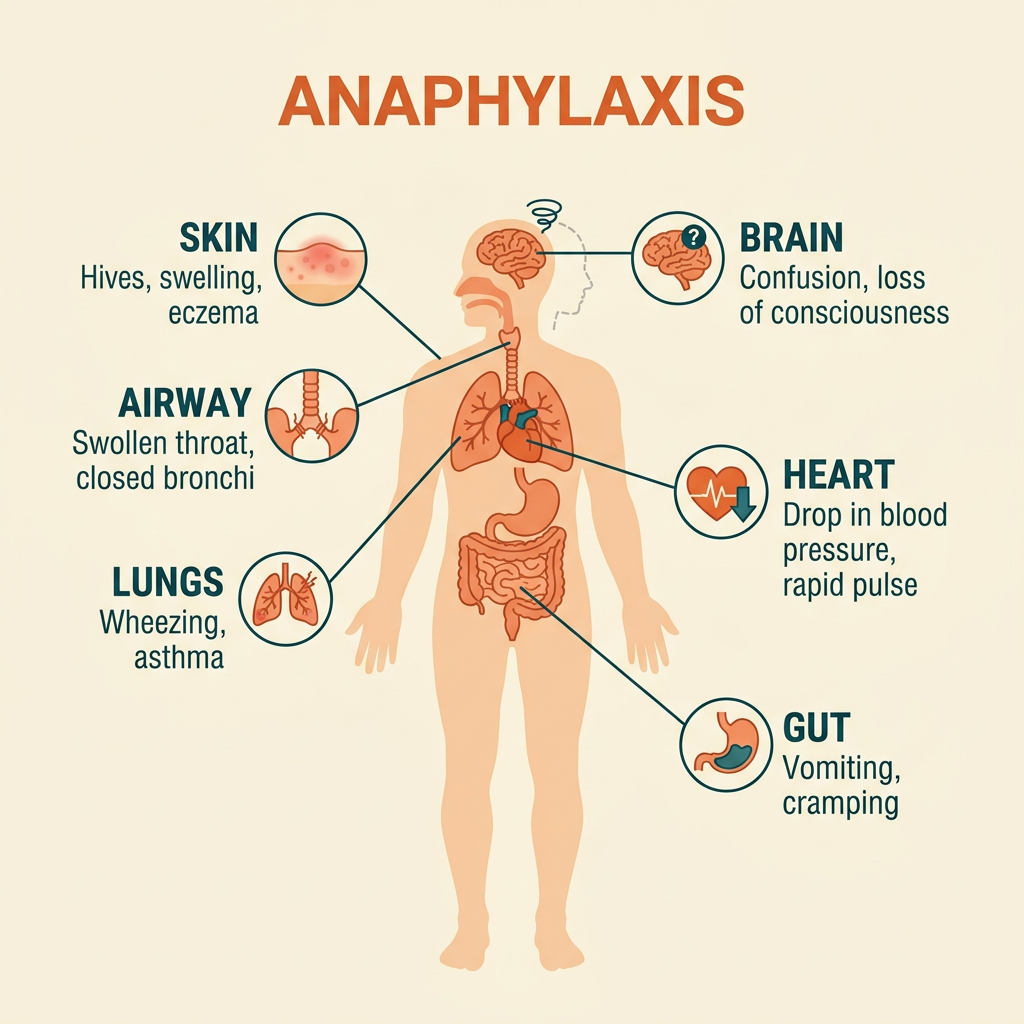
A whole-body emergency in under 10 minutes
Anaphylaxis is not 'a bad allergy.' It is a coordinated multi-system collapse. Skin, airway, lungs, heart, gut and brain all fail at the same time.
Without an immediate dose of epinephrine (an EpiPen) — which constricts blood vessels, opens airways, and stops mast cell degranulation — anaphylaxis is fatal. Antihistamines alone are not enough.
Up to 20% of severe reactions are biphasic — a second wave hits hours later, even after the first wave is treated. That's why every reaction means a hospital stay, not just a shot.
Food allergy is the #1 cause of anaphylaxis outside hospitals. Roughly 200,000 emergency room visits per year in the U.S. — one every three minutes — are caused by food-induced anaphylaxis.
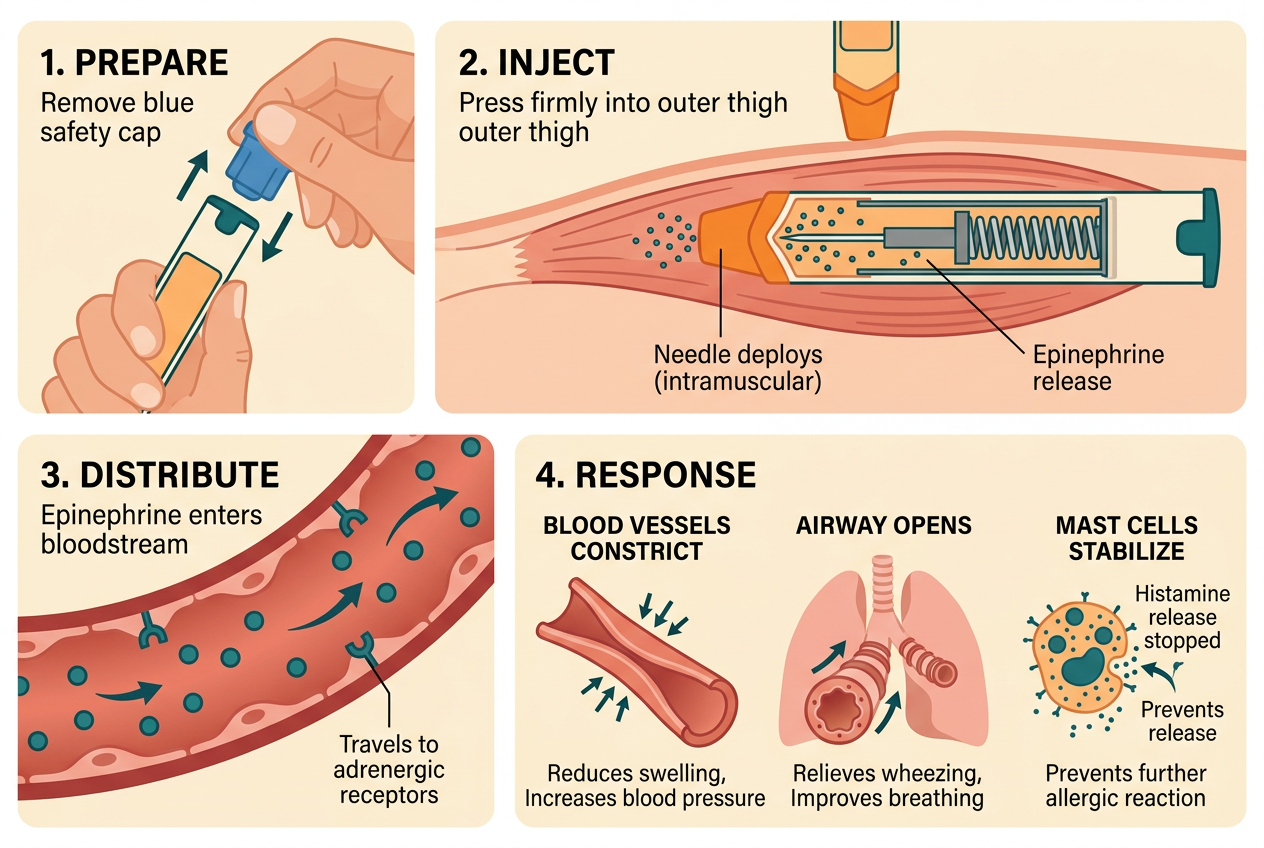
Epinephrine works — when it gets there in time
An EpiPen delivers a single 0.15 mg or 0.3 mg dose of synthetic adrenaline (epinephrine) straight into the thigh muscle. From there it floods the bloodstream and binds to alpha and beta adrenergic receptors throughout the body.
Within 60 seconds, epinephrine constricts blood vessels (raising plummeting blood pressure), relaxes airway muscles (reopening closed bronchi), and stabilizes mast cells so they stop releasing more histamine. It is the only medication proven to stop anaphylaxis.
But epinephrine is not a cure. It buys roughly 15–20 minutes — enough time to reach an emergency room. A second dose is often required. Up to 1 in 5 reactions are biphasic: a second wave hits 1–72 hours later, even after the first reaction was treated.
When It's Too Late
Sometimes the EpiPen isn't enough.
Why epinephrine sometimes fails:
- Delay. Studies show fatal reactions are most strongly linked to delayed administration — even 5 minutes can be the difference.
- No EpiPen on hand. Many fatalities involve an expired, lost, or absent device — at school, at a friend's house, on a field trip.
- Massive dose. Hidden allergens in restaurant or factory food can deliver thousands of times the threshold dose.
- Asthma + allergy. Co-existing asthma multiplies fatality risk by an estimated 7×.
- Wrong call. Symptoms are mistaken for a panic attack, an asthma flare, or "just hives" — and epinephrine is given too late.
The hard truths from the data:
- Roughly 150–200 Americans die each year from food-induced anaphylaxis (FARE / NIAID estimates).
- Teenagers and young adults with peanut/tree-nut allergies and asthma are the highest-risk group.
- Most fatal school reactions involve an allergen the child did not know was in the food — given by a friend, a teacher, or a cafeteria.
- In multiple documented cases, the child was carrying an EpiPen but was not given it in time.
Airborne Reactions
Lucian doesn't have to eat it. He just has to breathe near it.
When fish or shellfish is cooked, when peanuts are roasted, when milk is steamed for a latte, or when flour is poured — microscopic protein particles aerosolize into the air. Those particles travel on currents, settle on surfaces, and are inhaled into the lungs and absorbed through mucous membranes in the eyes and nose.
For a child sensitized at Lucian's level, that airborne exposure is enough to trigger hives, asthma, swelling, or full anaphylaxis. This is why a school cafeteria, a restaurant kitchen, a shared classroom snack, or even a stadium concession stand can become a life-threatening environment.
Cross-contact is invisible
A shared knife. A pan rinsed but not scrubbed. A conveyor belt that ran peanut bars before granola. Trace protein residue — measured in parts per million — is enough to send a sensitized child to the ER. "May contain" is not a warning Lucian's family can ignore. It is the warning.
Why "safer food" is a movement, not a menu
Lucian's Food exists because the science is unforgiving and the supply chain is not built for it. Top-15-allergen-free production, dedicated equipment, validated cleaning, and transparent labeling are the only way children like Lucian get to eat — at school, at the ballpark, in the hospital, at home — without fear.
Eczema, infections, and the allergens hiding in everyday products
For a child like Lucian, allergens aren't just on the plate. They're in the lotion, the shampoo, the prescription, and even the clothing — and chronic eczema turns every exposure into a potential skin infection.
Eczema rashes that crack open and get infected
Severe food allergies and eczema travel together. When the skin barrier is already broken, every scratch is a doorway for staph, strep, and other infections. What starts as an itchy patch can become weeping wounds, antibiotic courses, and hospital visits in a matter of days.
For Lucian, an eczema flare isn't a cosmetic problem — it's a daily fight to keep his skin intact so the next allergen doesn't get under it.
Allergens are hiding in things that never touch a plate
Food-allergen labeling laws stop at the grocery aisle. Lotions, shampoos, soaps, prescription medications, vitamins, vaccines, toothpaste, and even fabrics can contain milk, egg, soy, wheat, peanut, tree-nut, coconut, oat, or sesame derivatives — often unlabeled or buried under chemical names.
On broken eczema skin, those exposures don't just irritate — they sensitize and trigger reactions the same way ingestion does.
Lotions & creams
Oat colloidal, almond oil, shea, coconut, and milk proteins routinely appear in "gentle" baby and eczema creams — the exact products families reach for during a flare.
Shampoos & soaps
Wheat protein, oat extract, soy lecithin, and dairy derivatives are common in shampoos, body washes, and bubble baths — absorbed through scalp and broken skin.
Medications & vitamins
Inactive ingredients in prescriptions, OTC drugs, gummies, and chewables can include lactose, soy, gelatin, gluten, and tree-nut oils — rarely flagged on the front label.
Clothing & textiles
Casein-based finishes, soy fibers, and milk-protein "moisturizing" fabrics are marketed as skin- friendly — but for an allergic child, they're a wearable exposure.
What this means for our mission
Safer food is the start. The same standards we're building into Sentinel's manufacturing — transparent ingredients, dedicated equipment, top-15-allergen-free formulations — need to extend to the products families put on their kids, not just in them. Lucian's mission doesn't end at the kitchen.
What the FDA actually requires — and what it doesn't
The federal allergen labeling system protects against the most common 9 allergens on the ingredient line. It does almost nothing about cross-contamination, shared equipment, or the other top allergens Lucian reacts to.
FALCPA (2004)
The Top 8 Major Allergens
The Food Allergen Labeling and Consumer Protection Act required FDA-regulated packaged foods to clearly identify milk, eggs, fish, crustacean shellfish, tree nuts, peanuts, wheat, and soybeans when used as ingredients — by their common name, on the label, in plain English.
FASTER Act (2021)
Sesame becomes #9 — with unintended consequences
Sesame was added as the 9th major allergen as of January 2023. Instead of removing sesame, many large bakeries began intentionally adding it to all their products — because it was cheaper to label "contains sesame" than to clean shared equipment to a sesame-free standard. The law made some foods more dangerous, not less.
The Cross-Contact Loophole
The FDA does not require manufacturers to disclose cross-contact.
FALCPA only covers allergens that are intentionally added as ingredients. Trace allergen residue from shared equipment, conveyor belts, dust in the air, or rework streams is not regulated for labeling.
The phrases you see on packaging — "may contain," "manufactured in a facility with," "processed on shared equipment with" — are 100% voluntary. There is no FDA-defined threshold, no required testing, and no enforced standard format. Two facilities with identical contamination risk can label completely differently.
Translation: a product can legally test positive for peanut protein and still be sold without a peanut warning, as long as peanut wasn't an ingredient.
An interactive guide to every allergen warning
Most parents have to learn label literacy the hard way — sometimes after a reaction. Tap each phrase below to see what it actually means, what (if anything) the FDA requires, and exactly what to do at the grocery store and in the school cafeteria.
Interactive Label Decoder
What that allergen warning actually means
Tap any phrase below to see what the FDA actually requires, what the words really mean, and what parents and school nurses should do about it.
"Contains: milk, eggs, peanuts."
These allergens are intentionally in the product. By federal law, the manufacturer MUST tell you.
What it really means
Any of the FDA's Top 9 allergens (milk, eggs, fish, crustacean shellfish, tree nuts, peanuts, wheat, soybeans, sesame) used as an ingredient must be listed in plain English — either inside the ingredient list or in a separate 'Contains' statement directly below it.
What the FDA actually requires
Required under FALCPA (2004) and the FASTER Act (2021). This is the ONLY allergen statement on a U.S. label that is legally enforceable.
For school nurses & cafeteria staff
Treat 'Contains:' as truth. If your student reacts to anything listed here, this product is unsafe — full stop. Train staff that 'Contains:' is the first line of every label check.
For parents at the grocery store
Read the 'Contains' line FIRST, every single time — even on a brand you've bought before. Recipes change without warning, and a reformulation can add an allergen overnight.
Example you might see on a label
Ingredients: enriched flour, sugar, palm oil, cocoa, milk, soy lecithin. Contains: WHEAT, MILK, SOY.
The 6 allergens the FDA still ignores
Most allergy-aware countries — the EU, UK, Canada, Australia — regulate 14 to 15 allergens. The U.S. regulates 9. The gap is everything Lucian and millions of children react to.
FDA Required (Top 9)
- Milk
- Eggs
- Fish
- Crustacean shellfish
- Tree nuts
- Peanuts
- Wheat
- Soybeans
- Sesame
Not Required by FDA (but on EU/UK Top 14)
- Mustard
- Celery
- Lupin
- Mollusks
- Sulfites
- Gluten (beyond wheat)
Plus corn, coconut, legumes (peas, lentils, chickpeas), seeds (sunflower, poppy, hemp), and nightshades — which cause real reactions in U.S. children but have no federal labeling requirement at all.
There is no true Top-15-allergen-free contract manufacturer in America
We've looked. Families have looked. Hospitals have looked. The reality of U.S. food production is that almost every facility runs multiple product lines — and every one of those lines touches at least one of the top allergens.
"Allergen-friendly" ≠ allergen-free
Most "Top 8 free" or "Top 9 free" co-manufacturers still run wheat, dairy, soy, or nuts on adjacent lines or in the same facility. They control what they put in the product — not what gets on it.
Shared HVAC, shared rework, shared dust
Flour and milk powder become airborne. Allergen dust circulates through ventilation, settles on packaging machines, and contaminates "clean" products in the same building — even with cleaning between runs.
Validated cleaning ≠ validated safe for severe allergy
FDA-recognized allergen cleaning protocols are designed to reduce risk for the average consumer — not to bring residue below the <1 mg threshold a child like Lucian reacts to. Most facilities don't even test final lots for the allergens they're trying to exclude.
The economics don't favor safety
A truly dedicated Top-15-free facility runs one product family, validates every batch, and tests for each excluded allergen. That cost structure is why no one has built it as a contract manufacturer — and why families like Lucian's keep ending up making food themselves.
Why Lucian's Food Exists
The gap between what the law requires and what a child like Lucian actually needs — that's the gap we exist to close.
Our roadmap is not "Top 9 free." It is truly Top 15 free: dedicated equipment, validated cleaning, lot-level testing for every excluded allergen, and transparent labeling that goes beyond federal minimums. It's expensive. It's slow. It's the only way the families who need this most can ever trust what they hand their children.
Built from hospital rooms, survival, and a mother's solution
These are the real moments behind Lucian's Food: severe allergies, autism, airborne and cross-contact reactions, and the products created because safe food did not exist for him.
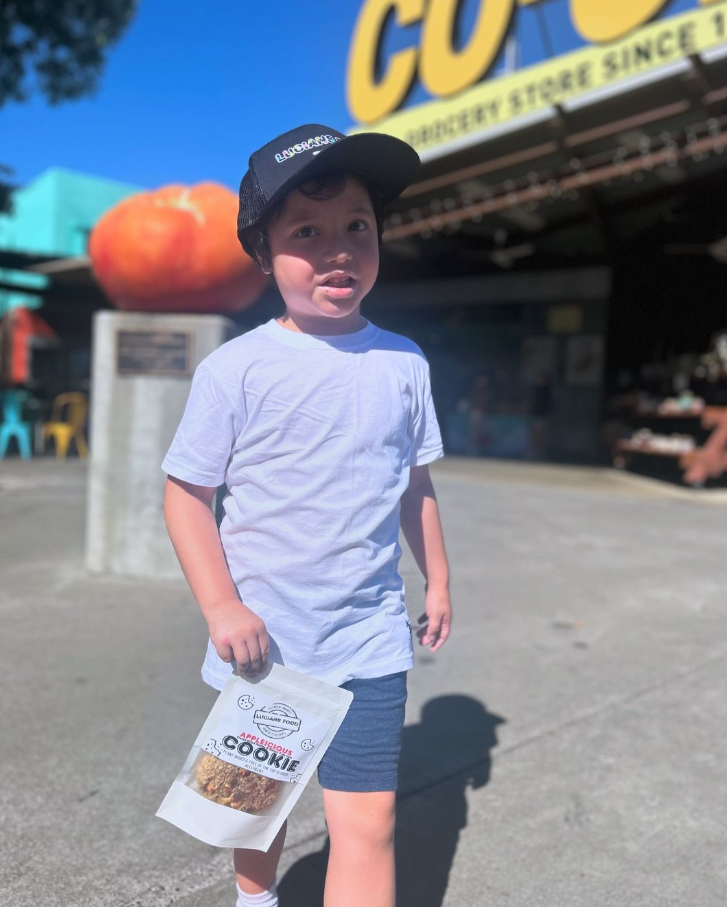
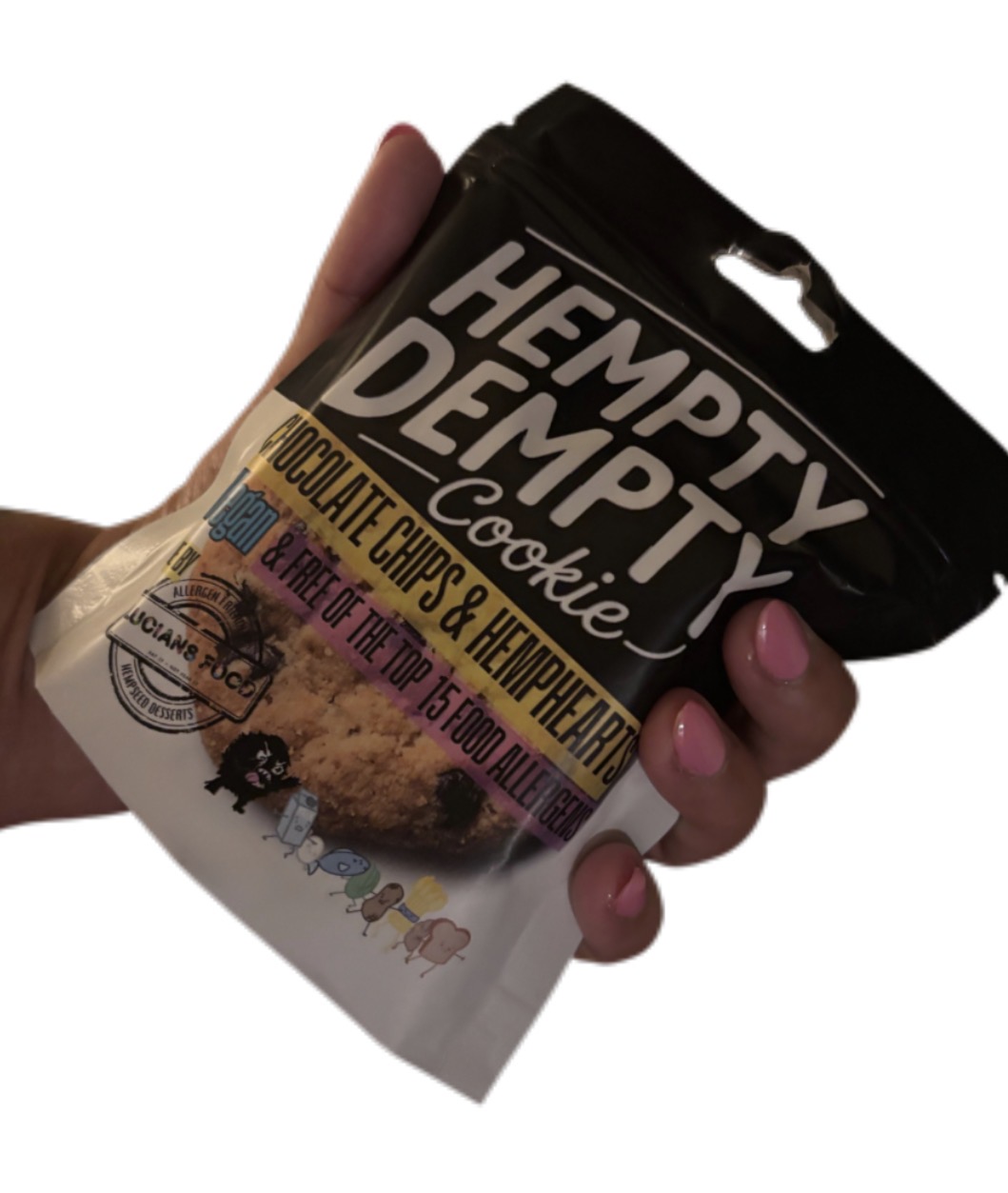
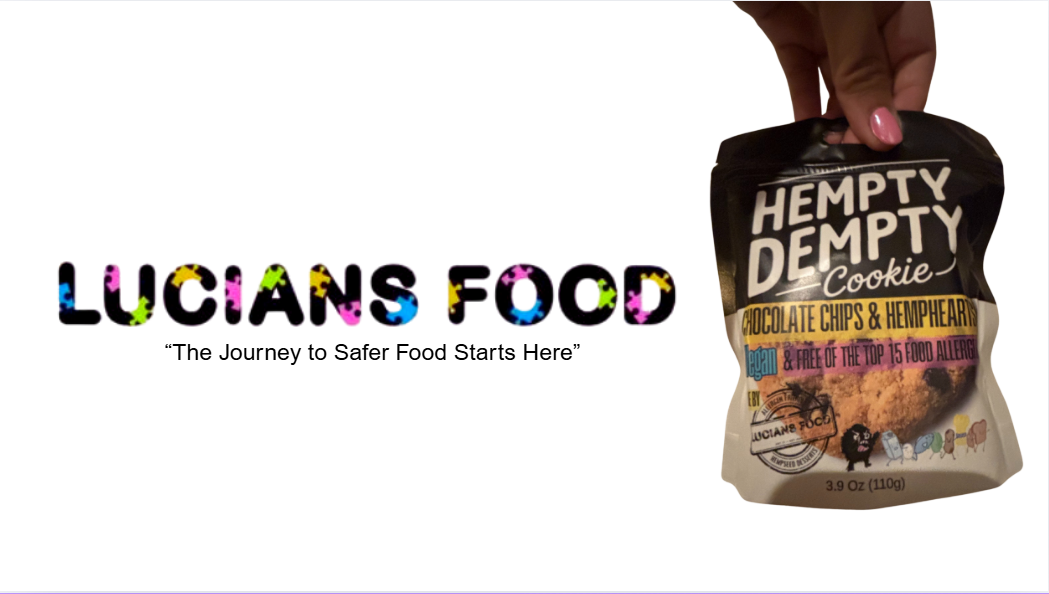
Bars, cookies, muffins, and supplemental hemp drinks — into schools, centers, and WIC.
The product line wasn't built for shelves. It was built for the places kids actually eat — classrooms, daycares, after-school programs, community centers, and the WIC families who need safer nutrition the most.
Cookies
Top-15-allergen-free, hempseed-powered. The lunchbox staple every allergic kid has been waiting for.
Bars
Shelf-stable protein and snack bars built for school nutrition programs and grab-and-go meals.
Muffins
Soft, kid-friendly breakfast and snack muffins — safe for sensory-sensitive kids and severe-allergy kids alike.
Supplemental hemp drinks
Hempseed-based nutritional drinks for kids who can't tolerate dairy, soy, oat, or nut milks.
The places we want them
Schools
Public schools, private schools, charter networks, daycares, preschools, and after-school programs. Top-15-free options that mean no child has to sit at the allergy table — or skip lunch entirely — ever again.
Centers
Community centers, autism and special-needs programs, pediatric clinics, hospital cafeterias, food pantries, and shelters — the places families turn to when food has to be both safe and accessible.
WIC
Women, Infants, and Children. Allergic kids in low-income households are the most under-served population in food allergy. We're building toward WIC-eligible products so safe nutrition isn't gated by income.
For partners in those programs
School nutrition directors, district administrators, community-center program leads, pediatric health systems, and WIC agencies — if any of these channels is yours, we want to talk about getting safer food in front of the kids who need it.
We want to launch our cookies worldwide. We can't do it alone.
Every Hempty Dempty cookie, every safer snack we've made was born in a kitchen built around one little boy. To put them in classrooms, hospitals, ballparks, and homes around the world, we have to build the facility that can produce them safely at scale.
A cookie kids like Lucian can actually eat
Top-15-allergen-free, hempseed-powered, and made the way every parent of an allergic child wishes cookies were made. Right now we make them for our community. The dream is to make them for every child who's ever had to say "I can't have that."
It only happens if the facility gets built
Worldwide distribution requires a real, allergen-engineered, vertically-integrated production facility — dedicated lines, validated cleaning, on-site engineering, and a supply chain we control. That's the Sentinel build. It is a serious lift and it needs serious help.
Then — cookies, worldwide
Schools, hospitals, retail shelves, and families across the country and beyond. The same safer cookie, made the same safer way, available to any child who needs it. That's the goal we're building toward — together.
We need help — every kind
Investors. Donors. Partners. Engineers. Schools. Policymakers.
This isn't a single check or a single partner. Building the facility that finally lets safer cookies reach every child takes a coalition — capital to build it, partners to scale it, engineers to design it, and policymakers to back it. If any of that sounds like you, we want to talk.
Your support powers safer meals, smarter education, and stronger families.
Donate, sponsor, or partner with Lucian's Food and help us reach the children who need us most.
Connect with Lucian's Food
Donors, school nutrition leaders, healthcare partners, and families — get in touch with the nonprofit team.